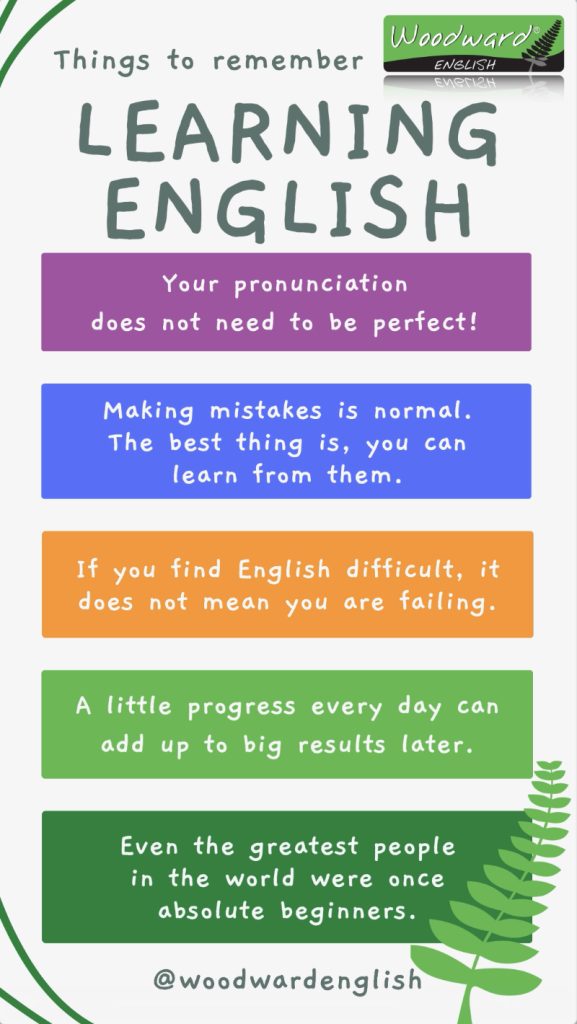
Your pronunciation does not need to be perfect!
Many learners want to sound exactly like a native speaker. But here is the truth: the goal of speaking is communication, not perfection. If people can understand you, you are doing a great job.
Think about this. English is spoken all over the world, by hundreds of millions of people with different accents. Someone from India, someone from Brazil, someone from Nigeria, someone from Japan: they all speak English differently, and they all communicate successfully. An accent is not a mistake. It is part of who you are, and it shows that you speak more than one language. That is something to be proud of!
Of course, you can still work on your pronunciation. Clear pronunciation helps people understand you. But aim for clear, not perfect. Focus on the important things: the main sounds, word stress, and the rhythm of the sentence.
So next time you feel shy about your accent, remember: speaking with an accent is much better than not speaking at all.
🎓 Aim for CLEAR, not PERFECT
Making mistakes is normal. The best thing is, you can learn from them.
Let me ask you a question. Have you ever learned to ride a bike, or to cook a new dish? Did you do it perfectly the first time? Of course not! You fell off your bike, or you burned the food or it didn’t taste how you expected, BUT then you tried to do it again and most likely did better.
Language learning is exactly the same. Every mistake is information. It shows you what you need to practise. When you say “I goed to the shop” and someone says “Oh, you went to the shop,” you have just learned the past tense of “go”. Next time, you will probably remember it.
Here is something very interesting: native speakers make mistakes too! They forget words, they mix up grammar, and they say the wrong thing sometimes. Mistakes are a natural part of using any language. Even though I have been teaching English for nearly 30 years, yes, every now and then I make mistakes. Yes, way back in 1984 … just kidding, I most likely made a mistake some time this week. It happens. It’s not the end of the world.
So please do not be afraid to speak. The people who improve fastest are usually not the ones who never make mistakes. They are the ones who try, make mistakes, notice them, and keep going.
Here is a simple tip: keep a small notebook of your mistakes or type them on your phone. Write the mistake, write the correct version, and look at it again in a few days. Soon you will see your own progress.
🎓 Mistake → Lesson → Progress
If you find English difficult, it does not mean you are failing.
Let’s be honest. English can be difficult! There are irregular verbs, weird spelling, phrasal verbs, and words that look the same but sound different. Think about “though”, “through”, and “tough”. Who decided that? (I know, but that’s for another lesson)
When something feels hard, it is easy to think, “Maybe I’m not good at languages,” or “Maybe I’m just too slow.” But that is not true. Feeling that something is difficult simply means that you are learning something new. Your brain is working hard, and that is exactly what learning feels like.
Also, remember that learning a language is not a straight line. Some days you will feel confident. Other days you will feel lost, and you might even forget words you knew yesterday. That is completely normal. It does not mean you are going backwards. It means you are human.
So when it gets difficult, be kind to yourself. Take a short break, review something easier, and then come back to it. Difficulty is not a sign of failure. It is a sign that you are growing.
🎓 Difficult ≠ Failing
A little progress every day can add up to big results later.
Many people believe they need to study for hours and hours to improve. But it is not about how much you study in one day. It is about how often you study.
Imagine two students. Student A studies for four hours once a week. Student B studies for just fifteen minutes every day. After a few months, Student B is usually doing much better, because the brain remembers things better when it meets them again and again.
Fifteen minutes a day might not feel like much. But look at it this way: that is over ninety hours in a year! Or think of it this way, five new words a day is more than 1,800 words in a year. Small steps become big results.
So make it easy. Listen to one short podcast on your way to work or on your way home. Read one page of a story. Watch a short video, like this one! Say three sentences out loud before bed. Do something small, every day, and keep going.
And on the days when you don’t feel like studying, do just five minutes. Often, once you start, you will want to continue.
🎓 Small steps + Every day = Big results
Even the greatest people in the world were once absolute beginners.
Think of a famous musician, a professional football player, a great writer, a brilliant scientist or an amazing English teacher. Today, they look so skilled that it seems like they were born that way. But every one of them started at zero. The musician once could not play a single note. The writer once struggled to write a good sentence. The football player once couldn’t do the basics.
What made them great was not that they never struggled. It was that they kept practising, kept learning, and did not give up.
The same is true for you. Right now, you may feel like a beginner, and that’s okay. Being a beginner is not something to be embarrassed about. It’s the first step of every success story.
In a year from now, you will be glad that you started today.
So be patient, and remember: you are not behind. You are on your way.
Everyone starts as a beginner!