Today I want to talk about something very important …
How to learn English in 2026.
Not how people used to learn English in the past.
Not how textbooks say you should learn English.
But how English learners can actually make progress today.
Because the truth is this:
English learning has changed – but many learners are still using old methods.
Let’s fix that.

1. Why Old Methods Don’t Work Anymore
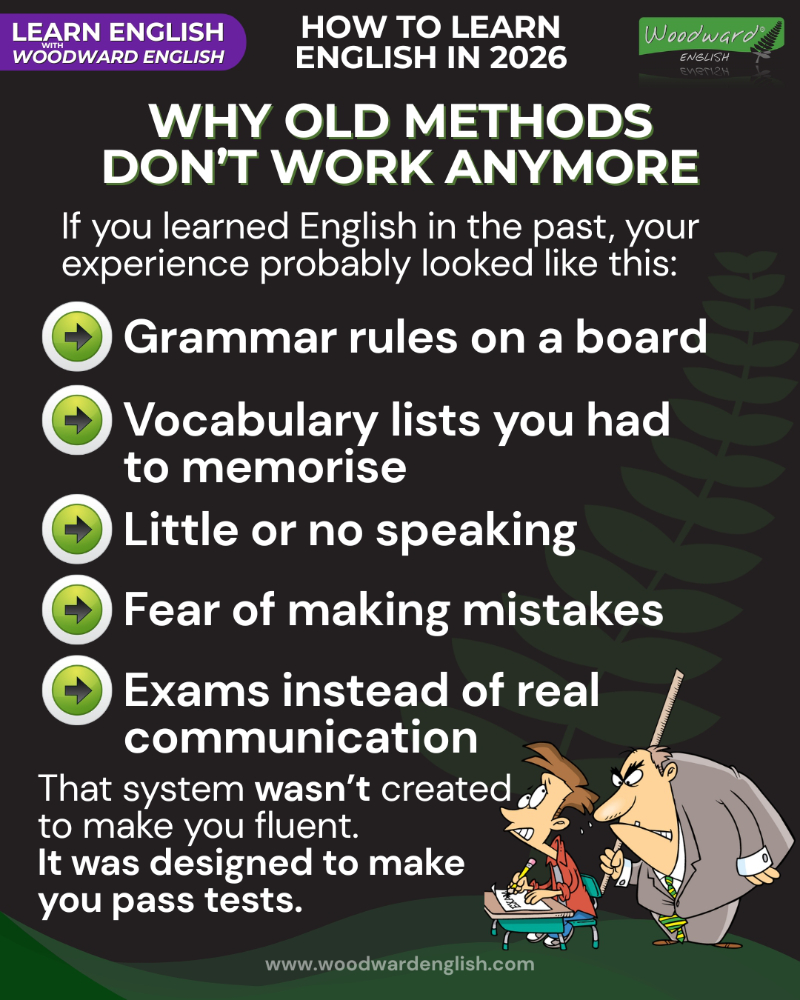
If you learned English at school, your experience probably looked like this:
- Grammar rules on a board that you had to copy into your workbook
- Vocabulary lists you had to memorise
- Little or no speaking because there were so many other students in the class OR sometimes just because the teacher did all the talking.
- Fear of making mistakes – Trying to be perfect all time, avoiding mistakes.
- Exams instead of real communication
That system wasn’t designed to make you fluent.
It was designed to make you pass tests.
Tests are easy to measure and put a number or grade to but I have seen people do well in tests yet they can’t say very much in English.
And in 2026, that approach simply doesn’t match how language actually works.
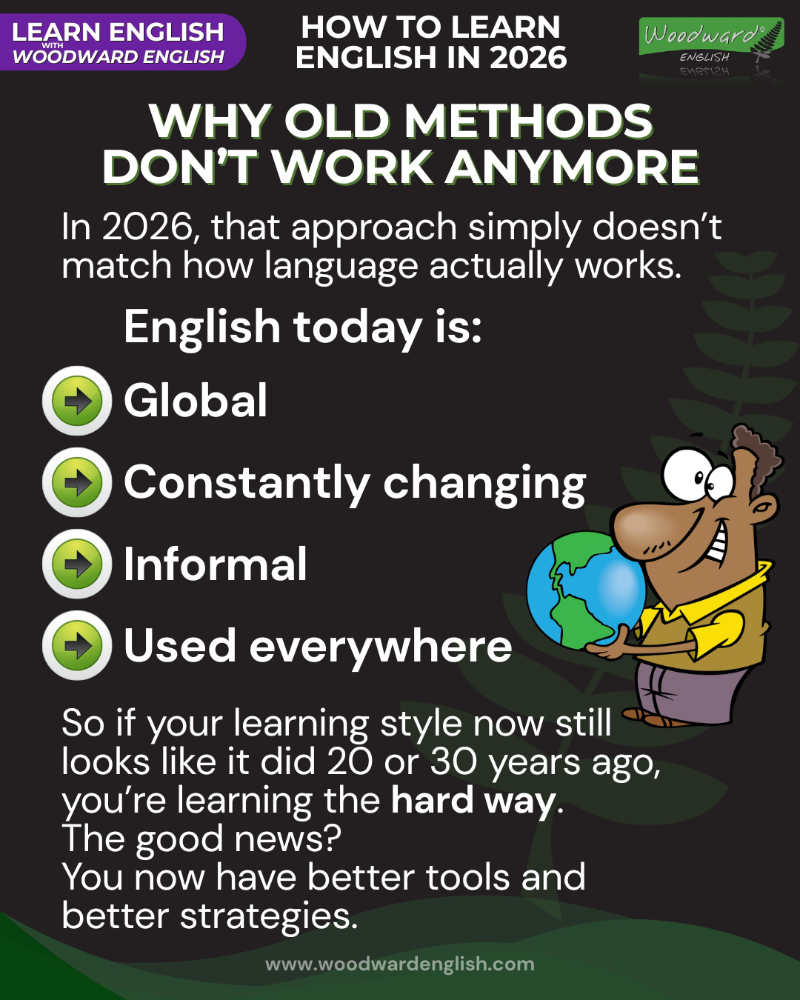
English today is:
- Global – with a variety of native and non-native accents and ways of saying things. And we’re not just talking about American English vs. British English.
- English today is Constantly changing with new words and expressions added all the time, mostly thanks to the internet.
- English today is Informal – Most communication is informal, including in some business environments. I have never said “How do you do?” in my loooong life. It’s too formal, I’ve met presidents, prime ministers and top CEOs and I have never say “How do you do?”
- English today is Used everywhere: online, at work, while travelling, and on social media.
So if your learning style still looks like it did 20 or 30 years ago, you’re learning the hard way.
The good news?
You now have better tools – and better strategies.
2. The Biggest Change: English Is Everywhere
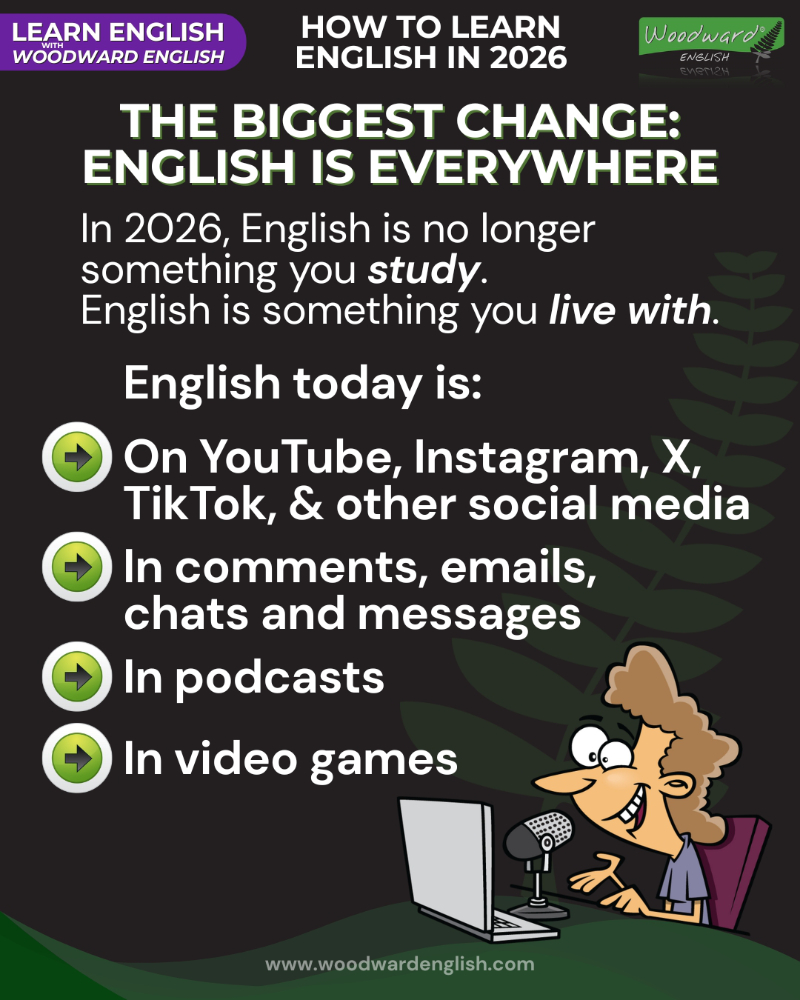
In 2026, English is no longer something you study.
English is something you live with.
Let me explain: Today, wherever you are in world, you can find English in:
- On YouTube, Instagram, TikTok, and X (or twitter) and other social media
- In comments, emails, chats and messages
- In podcasts (like this awesome podcast – totally unbiased)
- In video games
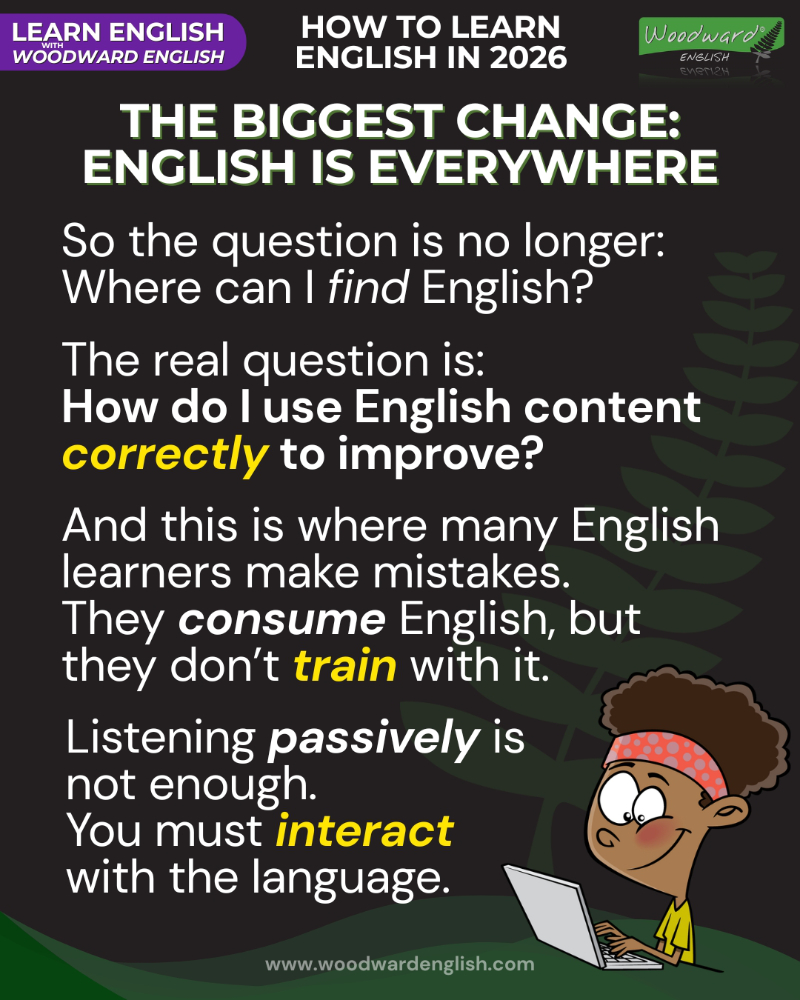
So the question is no longer:
“Where can I find English?”
The real question is:
“How do I use English content correctly to improve?”
And this is where many English learners make mistakes.
They consume English – but they don’t train with it.
Listening passively is not enough.
Scrolling passively through your feed is not enough
You must interact with the language.
3. The 2026 Learning Rule: Less Studying, More Training
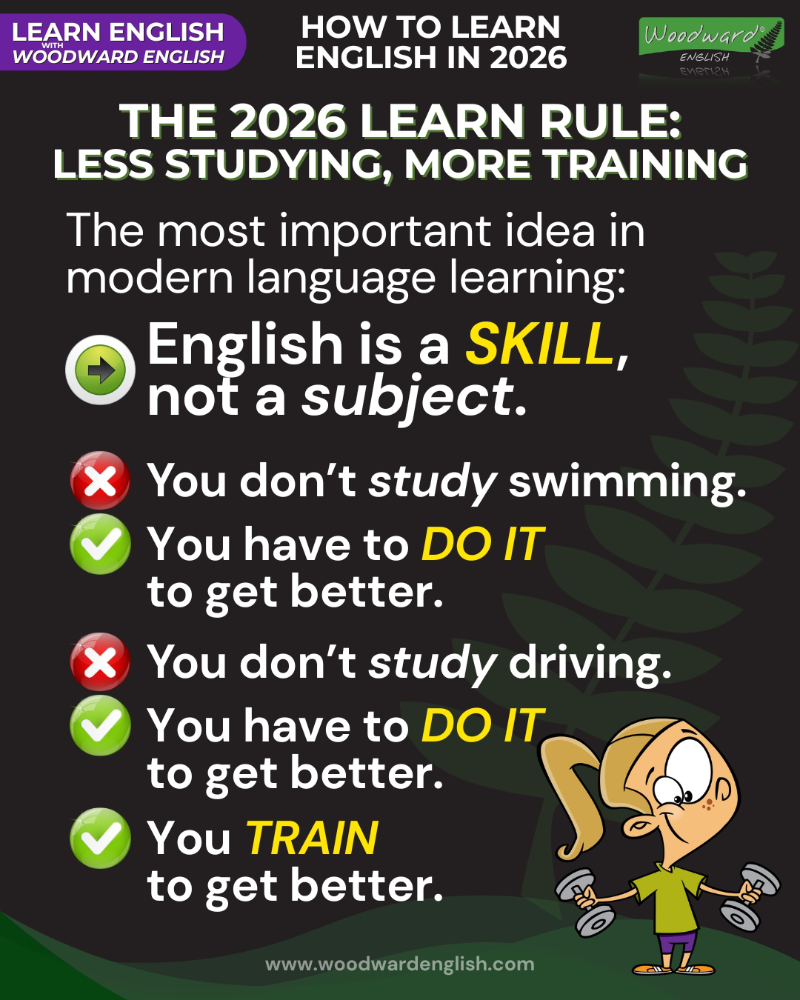
Here is one of the most important ideas in modern language learning:
👉 English is a skill, not a subject.
You don’t study swimming. You have to DO it to get better.
You don’t study driving. You have to DO it to get better.
You train to get better, not just read or watch someone explaining it.
And this applies to English too. You need to TRAIN with the language, you must use and interact with the language in order to get better.
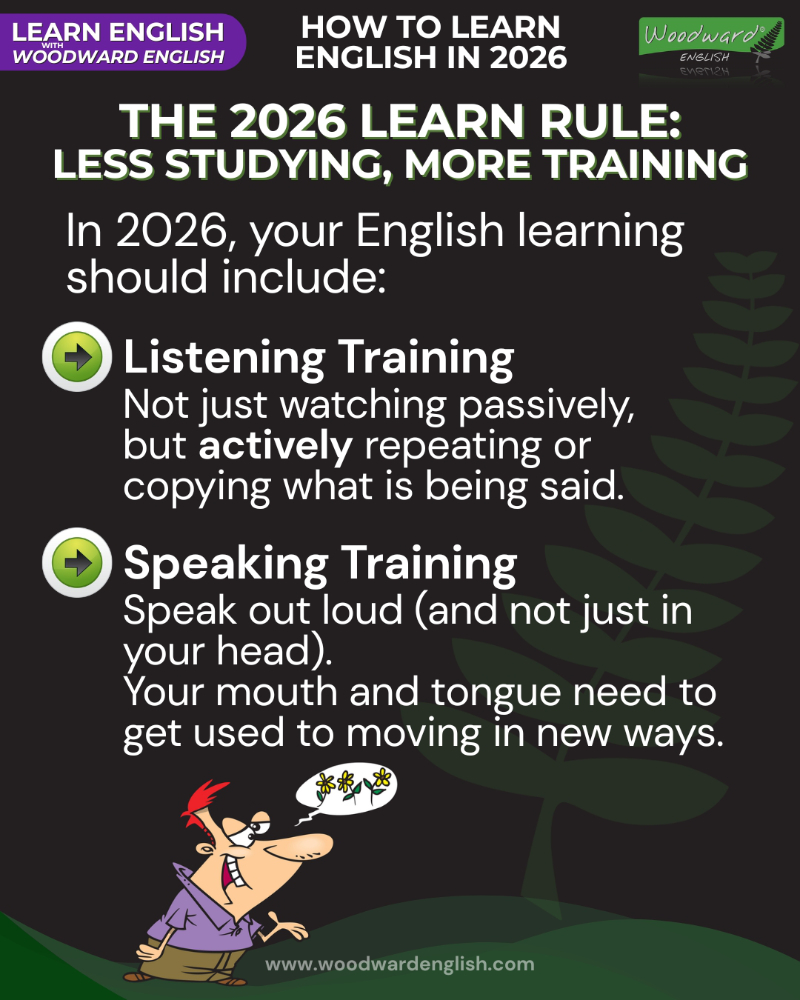
So in 2026, your English learning should include:
✅ Listening training
Not just watching (passively) – but actively repeating or copying what is being said. We have another English podcast with hundreds of expressions in English about daily routines where you can pause after each sentence and try and repeat what I say. This leads us to …
✅ Speaking training
Speak Out loud (and not just in your head). Your mouth and tongue need to get used to moving in new ways. Speak every day and hopefully more than once. Try speaking in the morning, in the afternoon and at night. It doesn’t have to be for a long time. Even five minutes each time will help (or course more is even better). And don’t use the excuse that you don’t have anyone to speak to. If there isn’t anyone you can talk to, not even online … then speak alone!
4. AI, Apps, and Technology — The Right Way to Use Them
Let’s talk about technology, because in 2026 this is impossible to ignore.
AI, apps, online tools — they are everywhere.
And for English learners, this is both amazing and dangerous.
Amazing, because learners today have more help than ever before.
Dangerous, because it’s very easy to feel productive without actually improving.
Here’s the first thing I want to say very clearly:
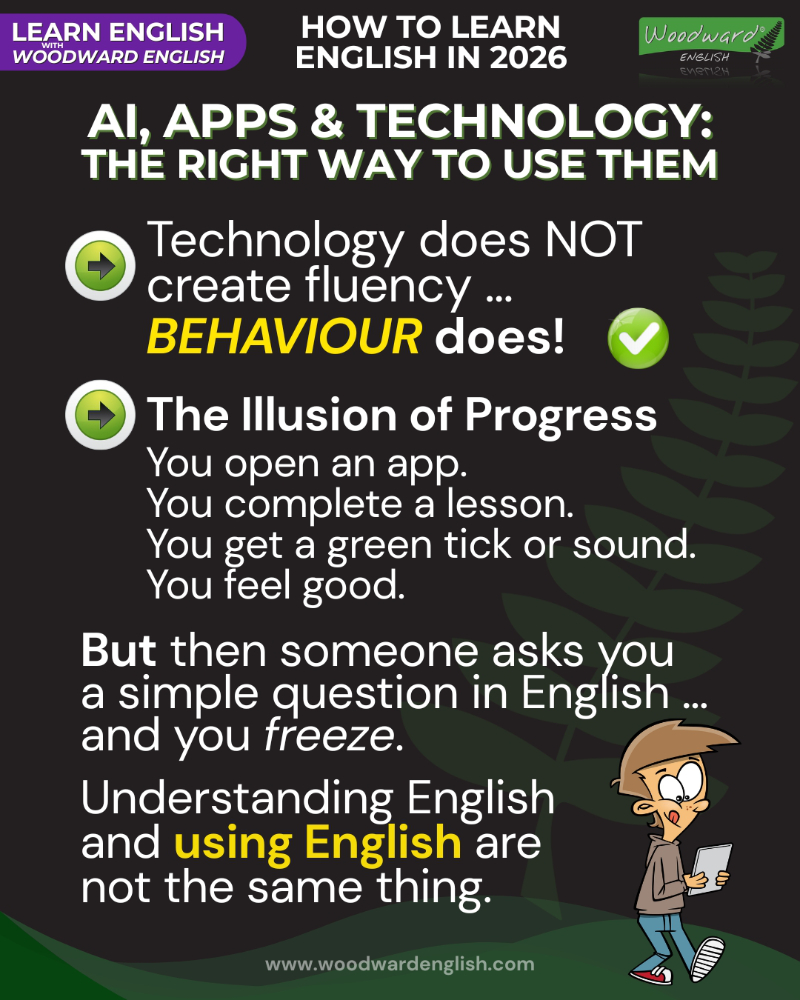
👉 Technology does not create fluency. Behaviour does.
You can have the best apps in the world, the smartest AI, and perfect explanations — and still not speak English confidently if you don’t use the language.
There is an Illusion of Progress
One of the biggest problems I see with modern learners is what I call the illusion of progress.
- You open an app.
- You complete a lesson.
- You get a green tick or some motivating sound
- You feel good. (Dopamine YAY!)
But then someone asks you a simple question in English … and you freeze.
That doesn’t mean you’re bad at English.
It means the tool trained the wrong skill.
If your entire English routine is:
- tapping
- matching
- choosing A, B, or C
Then you are training your thumb, not your mouth.
Understanding English and using English are not the same thing.
How Apps Should Be Used in 2026
So here’s the rule I recommend in 2026:
👉 If an activity doesn’t involve your voice, it’s incomplete.
Use apps – but always add speaking.
- Repeat sentences out loud.
- Read answers out loud.
- Say your mistakes out loud.
And then we have AI .. Artificial Intelligence.
What AI Is Actually Good At:
AI can be good when you use it correctly.
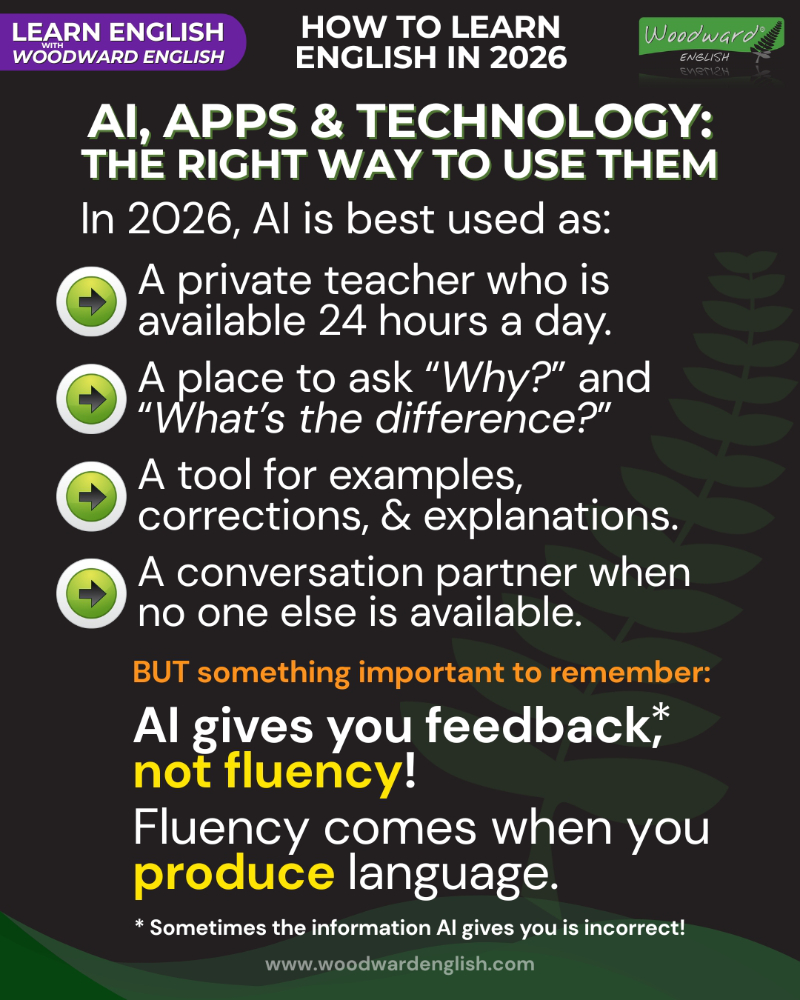
In 2026, AI is best used as:
- A private teacher who is available 24 hours a day.
- A place to ask “Why?” and “What’s the difference?”
- A tool for examples, corrections, and explanations
- A conversation partner when no one else is available
For example, AI can:
- Explain the difference between “I’ve been working” and “I worked”
- Rewrite your sentence in more natural English
- Give you 10 examples of a phrase in context
- Correct your writing and explain the mistake
That’s powerful.
But notice something important:
AI gives you feedback*, not fluency.
* Sometimes the information that AI gives you is incorrect.
Fluency comes when you produce language.
5. The Most Important Skill in 2026: Speaking Confidence
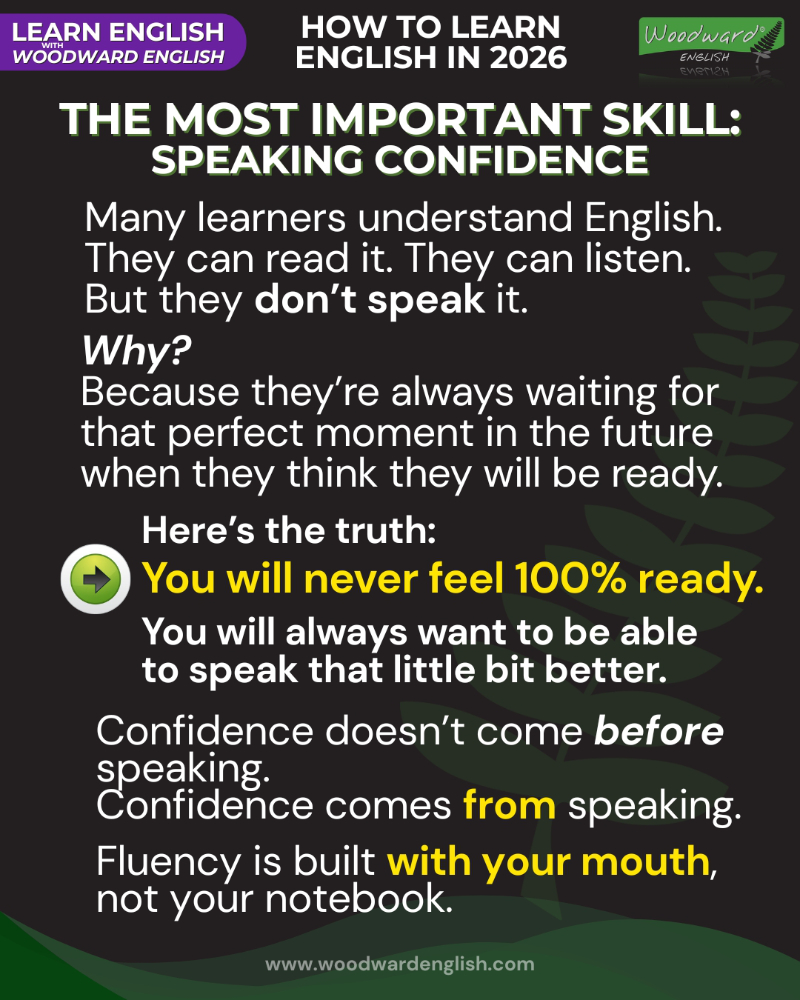
Many learners understand English.
They can read.
They can listen.
But they don’t speak It.
Why?
Because they’re waiting to be “ready”.
They’re always waiting for that perfect, magically moment in the future when they think they will be ready.
The same thing happened to me when I was learning Spanish. I had been in Chile for 3 months and couldn’t say a thing, all because I was wouldn’t try and speak the language, always waiting for that perfect moment when I knew some more and then would be “ready”.
But here’s the truth:
👉 You will never feel 100% ready.
You will always want to be able to speak that little bit better.
Once I started using Spanish despite all the mistakes I was saying, THAT was when I really started learning so much and started to improve my Spanish and become more confident with it.
Confidence doesn’t come before speaking.
Confidence comes from speaking.
Fluency is built with your mouth, not your notebook.
Even speaking 5 minutes a day out loud can change everything.
- Say your thoughts.
- Describe your day.
- Repeat sentences you hear.
- Talk to yourself.
6. A Simple 2026 English Learning Plan
Let me give you a simple, realistic daily plan:
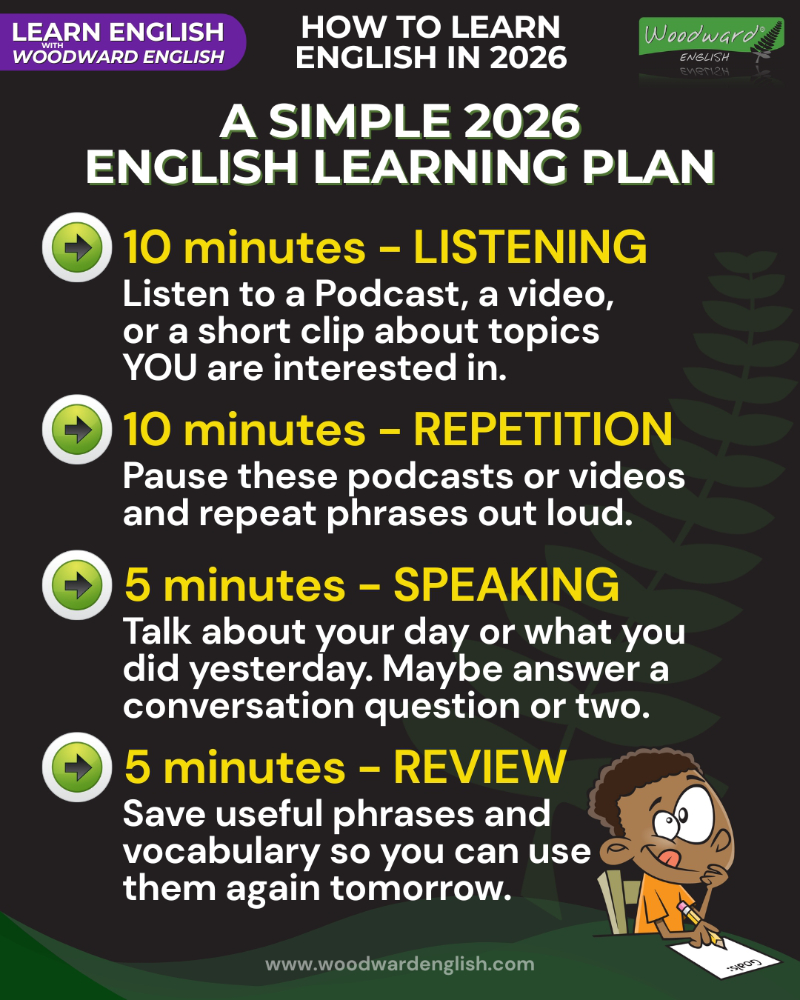
10 minutes – Listening
Listen to a Podcast, a video, or a short clip about topics YOU are interested in.
10 minutes – Repetition
Pause these podcasts or videos and repeat phrases out loud. Try and copy the style and proNUNciation of the speaker.
5 minutes – Speaking
Talk about your day or what you did yesterday. Maybe answer a question or two like the conversation questions we have.
5 minutes – Review
Save useful phrases and vocabulary so you can use them again tomorrow.
That’s 30 minutes a day.
Not perfect.
Not complicated.
But extremely powerful.
So, how will YOU learn English in 2026?
- Stop using old methods of learning
- Stop waiting for perfection
- Start training like it’s a skill
- Use real English every day
And remember this:
👉 You don’t need better English to start speaking.
You need to speak to get better English.
Thank you for listening.
If this lesson helped you, come back for the next episode, or even better, come and join us live – and keep learning, one small step at a time.
And until next time … Have an awesome day!